Thursday, November 26, 2009
Honesty, by Billy Joel
Honesty, by Billy Joel -- a song I've been listening to lately. Every word is true.

Thursday, November 19, 2009
Wednesday, November 18, 2009
Saturday, November 07, 2009
The Verdict?
I saw an energy psychologist last week -- at great expense, and against my own intuition. I'm not sure what prompted me to go, I more or less trusted Jason's judgment, because he's helped me before. I also was in a desperate state.
The long and short of it was that I saw her for about 6 straight hours, in which she did her "channeling" which I felt very uneasy about. In any case, the general verdict was that I am, in fact, addicted to suffering -- there are chemicals that get released in the body under any psychological state that can become addictive.
I have struggled with this for the past few days. I always prided myself that I am not, even though depressed, dependent on drugs or alcohol. But I never really seriously considered whether I might be addicted to misery or suffering or pain. I must admit, at the moment, that it might explain matters. But I can't help thinking, also, that it is ridiculous. There is also the issue that animal protein contains the suffering of the slaughtered animals and therefore , seeing that I'm empathic in the first place, I might be picking up in a big way the animal's energy, because I do eat a heck of a lot of animal protein. I find it to be grounding.
So, the verdict, as stated, might be that I'm addicted to suffering, and that fact is what is preventing me from making all kinds of growth, spiritual and otherwise. In that case, the therapist said I must find for myself other avenues, besides suffering and torment, that might lead me to illumination because, she assures me, I will not succeed in the manner I've been trying. She claimed that she opened my mind up during the session to contemplating other ways of growth, that is, she consulted with my subconscious mind and reprogrammed it.
So, if I am addicted to suffering, the solutions may be apparent. Firstly, I can use my subliminals to help reprogram my mind by writing, say "I am no longer addicted to suffering." and watch what happens. I can also rely on Tracy's (the psychologist's) own reprogramming. I can also watch my meat intake, which seems to exacerbate my problem. Other than that, I think I'll just have to wait and see how things go the next few days.
The long and short of it was that I saw her for about 6 straight hours, in which she did her "channeling" which I felt very uneasy about. In any case, the general verdict was that I am, in fact, addicted to suffering -- there are chemicals that get released in the body under any psychological state that can become addictive.
I have struggled with this for the past few days. I always prided myself that I am not, even though depressed, dependent on drugs or alcohol. But I never really seriously considered whether I might be addicted to misery or suffering or pain. I must admit, at the moment, that it might explain matters. But I can't help thinking, also, that it is ridiculous. There is also the issue that animal protein contains the suffering of the slaughtered animals and therefore , seeing that I'm empathic in the first place, I might be picking up in a big way the animal's energy, because I do eat a heck of a lot of animal protein. I find it to be grounding.
So, the verdict, as stated, might be that I'm addicted to suffering, and that fact is what is preventing me from making all kinds of growth, spiritual and otherwise. In that case, the therapist said I must find for myself other avenues, besides suffering and torment, that might lead me to illumination because, she assures me, I will not succeed in the manner I've been trying. She claimed that she opened my mind up during the session to contemplating other ways of growth, that is, she consulted with my subconscious mind and reprogrammed it.
So, if I am addicted to suffering, the solutions may be apparent. Firstly, I can use my subliminals to help reprogram my mind by writing, say "I am no longer addicted to suffering." and watch what happens. I can also rely on Tracy's (the psychologist's) own reprogramming. I can also watch my meat intake, which seems to exacerbate my problem. Other than that, I think I'll just have to wait and see how things go the next few days.
Wednesday, November 04, 2009
Wednesday, October 21, 2009
Dominus Illuminatio Mea

That's the motto for Oxford University -- isn't it a coincidence that I was born in the year of the ox? The motto is taken from the 27th Psalm. It's usually translated as "The Lord is my light."
Monday, October 19, 2009
Jay's Mantra
This is a mantra given to me by Jason. It has been surprisingly helpful for me, so I thought I would share it.
"From the God spark of 100% pure love and light that I am, I connect to source and give thanks and ask that all aspects of my being in all of my bodies and all dimensions, and all beings connected to me in all my bodies and all dimensions, be changed over to 100% pure love and light with no dark influence in godspeed. I take it that my requests are being answered and I thank you very much for your help."
I tend to read this in silence -- after reading that all speech actually can attract various entities into the energy field.
"From the God spark of 100% pure love and light that I am, I connect to source and give thanks and ask that all aspects of my being in all of my bodies and all dimensions, and all beings connected to me in all my bodies and all dimensions, be changed over to 100% pure love and light with no dark influence in godspeed. I take it that my requests are being answered and I thank you very much for your help."
I tend to read this in silence -- after reading that all speech actually can attract various entities into the energy field.
Tuesday, October 06, 2009
Perspective Drawing
Perspective drawing is based on the non-Euclidean "discovery" that all parallel lines actually do meet if extended far enough, in contrast to Euclid's famous fifth axiom.
Perspective is probably the most important aspect of art -- the difference between a childhood drawing and an adult drawing is the addition of perspective. Actually perspective is a difficult thing apparently to grasp. It took me four years, from the time I started doodle drawings in mid-2005 to now, late 2009, to gain a beginning understanding of perspective drawing. I think part of the reason was that I didn't understand or appreciate the explanations in most drawing texts. Actually, I'm sure I could have learned perspective-drawing when I was in grade 1 because I remember being very interested in drawing at the time and rummaging through all the drawing books in the school library -- but none, alas, contained anything informative on perspective-drawing. I started to gain my own grasp of perspective drawing just this past week when I noticed that the kitchen tiles next to where I was sitting were apparently much longer than the tiles just a few feet from me; and the tiles closer to me were also apparently much wider apart than those at a distance. That lead me to try to mimic the floor on the page in such a way the tiles further from me took up progressively less room on the page (see the floor on the drawing below).
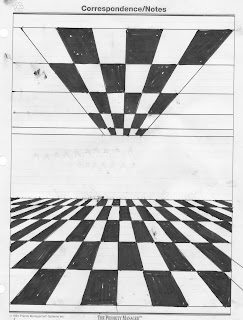
I think that perspective-drawing is very important for the experience of "illumination" of the mind -- the subject this blog has come to be about. The reason being that it allows the mind to see that the senses -- well, sight particularly -- reveal nothing as it actually is -- the distortions of perception come glaring through when the mind is made to reproduce perception through visual art. The mind realizes that, given the fact that it is able to apprehend the illusion of visual perception, it must partake, at least in part, of a reality higher than the one to which it is normally exposed as a result of sensory experience; otherwise it could never perceive the illusion as illusion in the first place -- it would simply be stuck in that reality. This is the beginning of illumination.
If we look again at the drawing of the floor above, we notice that the horizontal lines, although they get closer together as they move up the page, still remain horizontal to each other. In contrast, the more vertical lines, constituting the sides of the tiles, actually all converge to a single, though not delineated, point. This type of drawing is called one-point perspective because eventually one set of lines converges to one point -- perhaps it should more properly be called one-vanishing-point perspective because the point is termed the vanishing point.
Most art books when discussing perspective do not show the horizontal lines as getting progressively closer together as I did -- I think it's a good idea, though, to draw these lines as gradually converging in order to get an initial understanding of perspective-drawing. Practiced artists do not draw horizontal lines at all, their grid consisting only of a vanishing point and a series of lines converging to that point. I will illustrate this with three drawings of "boxes" below. Note that the front of each box (and the back as well) consists solely of horizontal and vertical lines, but the lines joining front to back all converge to one point, the vanishing point.
Perspective is probably the most important aspect of art -- the difference between a childhood drawing and an adult drawing is the addition of perspective. Actually perspective is a difficult thing apparently to grasp. It took me four years, from the time I started doodle drawings in mid-2005 to now, late 2009, to gain a beginning understanding of perspective drawing. I think part of the reason was that I didn't understand or appreciate the explanations in most drawing texts. Actually, I'm sure I could have learned perspective-drawing when I was in grade 1 because I remember being very interested in drawing at the time and rummaging through all the drawing books in the school library -- but none, alas, contained anything informative on perspective-drawing. I started to gain my own grasp of perspective drawing just this past week when I noticed that the kitchen tiles next to where I was sitting were apparently much longer than the tiles just a few feet from me; and the tiles closer to me were also apparently much wider apart than those at a distance. That lead me to try to mimic the floor on the page in such a way the tiles further from me took up progressively less room on the page (see the floor on the drawing below).

I think that perspective-drawing is very important for the experience of "illumination" of the mind -- the subject this blog has come to be about. The reason being that it allows the mind to see that the senses -- well, sight particularly -- reveal nothing as it actually is -- the distortions of perception come glaring through when the mind is made to reproduce perception through visual art. The mind realizes that, given the fact that it is able to apprehend the illusion of visual perception, it must partake, at least in part, of a reality higher than the one to which it is normally exposed as a result of sensory experience; otherwise it could never perceive the illusion as illusion in the first place -- it would simply be stuck in that reality. This is the beginning of illumination.
If we look again at the drawing of the floor above, we notice that the horizontal lines, although they get closer together as they move up the page, still remain horizontal to each other. In contrast, the more vertical lines, constituting the sides of the tiles, actually all converge to a single, though not delineated, point. This type of drawing is called one-point perspective because eventually one set of lines converges to one point -- perhaps it should more properly be called one-vanishing-point perspective because the point is termed the vanishing point.
Most art books when discussing perspective do not show the horizontal lines as getting progressively closer together as I did -- I think it's a good idea, though, to draw these lines as gradually converging in order to get an initial understanding of perspective-drawing. Practiced artists do not draw horizontal lines at all, their grid consisting only of a vanishing point and a series of lines converging to that point. I will illustrate this with three drawings of "boxes" below. Note that the front of each box (and the back as well) consists solely of horizontal and vertical lines, but the lines joining front to back all converge to one point, the vanishing point.

I might reiterate that in one-point perspective the vertical and horizontal lines exhibit "zero-point perspective", in other words they do not converge to any vanishing point but remain forever parallel, as per Euclidean geometry. Only the lines extending into the page exhibit perspective (in one-point perspective drawings), and therefore, only they converge to a vanishing point. A box or cube consists of three sets of parallell lines, the horizontal, the vertical, and those extending into the page. Again, in one-point perspective only the latter converge to a single point. This next drawing is also one-point perspective but without grid lines. In this case several cubes take up the page; the one beneath that is the same drawing, with one cube added, but with the grid lines included.

You can see in the picture with the grid lines that the sides of the cubes moving into the page all converge towards the single vanishing point. In two-point perspective, the boxes are viewed from such an angle that not only the sides but also the 'fronts' of the boxes exhibit perspective. Here are two identical illustrations but with the grid lines drawn in the second. Note that in two-point perspective, the vertical lines are still parallel to each other, i.e., they are not drawn in perspective.


This next picture is two-point perspective with the second vanishing point being well off the page, to the left. In this case, we see that the further one vanishing point is from an object, and the more the other vanishing point is directly behind the object, rather than to its side, the more we approach one-point perspective.

The last picture is three-point perspective, where the final set of lines, the vertical lines, is finally included in the perspective -- such drawings are usually called birds-eye or worms-eye view. The picture below is an example of the latter, i.e. looking up at a really tall 'building'.


Sunday, October 04, 2009
M. P. Hall on Aesthetics
"In its truest sense, therefore, aesthetics may be considered a philosophic discipline by which the consciousness of man is equipped to estimate the degree of beauty, the degree of virtue, and the degree of utility inherent in the nature of an object; also the power to discern how these qualities may be increased to ultimate perfection. The first work is, therefore, to establish the nature of beauty in its most comprehensible sense; likewise, the natures of virtue and utility. Before beauty is cognizable, however, in other than its transitory and inconsequential sense, the consciousness of him who would constitute himself its criterion must be elevated to that level of rationality on which the principle of beauty exists dissociated from the clumsy efforts of men to express its qualities. Upon the basis that only the beautiful was capable of recognizing the beautiful, the assumption of the philosophic life was regarded as indispensable to the recognition of the aesthetics of Divinity."
"Beauty, existing independent of form and as a divine principle, is likened to a fountainhead of existence, from which streams of beauty flow forth to permeate and beautify the whole inferior creation. Furthermore, the beauty of the inner nature greatly transcends to the beauty of the outer, for the spiritual essences constituting the supersubstantial man, being more proximate to Cause, partake more fully of the nature of Cause, which is true Beauty. Hence, as Plotinus observes, there are those who "on perceiving the forms of gods or daemons, no longer esteem the fairest of corporeal forms."
"The quest of the truly beautiful is therefore identical with the quest of self, for Self in its perfect and universalized sense -- the all-pervading Consciousness postulated by the sage -- is the perfect source of all beauty and therefore paretakes in perfect measure of all that which is manifested from itself. That this supreme truth was taught by the sacred institutions of antiquity is further evidenced by Plotinus, who continues: "Just as those who penetrate into the holy retreates of sacred mysteries, are first purified, and then divest themselves of their garments, until some one, by such a process, having dismissed every thing foreign from the God, by himself alone, beholds the solitary principel of the universe, sincere, simple, and pure, from which all things depend, and to whose transcendent perfections the eyes of all intelligent natures are directed, as the proper cause of being, life, and intelligence.""
Lectures on Ancient Philosophy (italics mine)
"Beauty, existing independent of form and as a divine principle, is likened to a fountainhead of existence, from which streams of beauty flow forth to permeate and beautify the whole inferior creation. Furthermore, the beauty of the inner nature greatly transcends to the beauty of the outer, for the spiritual essences constituting the supersubstantial man, being more proximate to Cause, partake more fully of the nature of Cause, which is true Beauty. Hence, as Plotinus observes, there are those who "on perceiving the forms of gods or daemons, no longer esteem the fairest of corporeal forms."
"The quest of the truly beautiful is therefore identical with the quest of self, for Self in its perfect and universalized sense -- the all-pervading Consciousness postulated by the sage -- is the perfect source of all beauty and therefore paretakes in perfect measure of all that which is manifested from itself. That this supreme truth was taught by the sacred institutions of antiquity is further evidenced by Plotinus, who continues: "Just as those who penetrate into the holy retreates of sacred mysteries, are first purified, and then divest themselves of their garments, until some one, by such a process, having dismissed every thing foreign from the God, by himself alone, beholds the solitary principel of the universe, sincere, simple, and pure, from which all things depend, and to whose transcendent perfections the eyes of all intelligent natures are directed, as the proper cause of being, life, and intelligence.""
Lectures on Ancient Philosophy (italics mine)
Random Writings on a Bed
Growth, generation, is not a quantity but a quality of being.
Thought is not a quantity but a quality of being.
Emotion is not a quantity but a quality of being.
Objective experiences/sensations are recorded in subjective bodies (surrounding objective body) .
Study, true study, is not the introduction of concepts into the mind but the reception of the mind of that which is greater than it. It is not an active mental process, therefore, but a passive one. Study is not the use of the mind as an active agent . When the mind serves as a channel for truth, the mind approaches illumination.
What is "intrinsic" is what is beyond mind and consequently beyond creation.
The predicament of man is that he is not life nor lifelessness, he is suspended betwixt the two. His "free will", his egoic self, his mind principle, allows him to choose between the two extremes. Almost invariably he chooses death because temporal reality is evident, whereas eternal reality is only imminent.
The mind of man is his only salvation, but also his greatest enemy. The problem is that man is not a mind-being -- he is a universal being, a divine being, a spiritual being. The egoic-consciousness is locked within the principle of mind, the Orphic egg from which Phanes, the universal savior, must burst forth for illumination to occur.
Beauty exists without mind, and mind is a condition of the beautiful.
The mediocre mind believes that it can think its way to knowledge. The disillusioned mind knows that it is properly the servant of the real and so long as it tries to be its arbiter, it will be the slayer of the real.
The mind can receive life, it cannot bestow life.
My lifelong search for perfection has lead me to the conclusion that perfection can never be conceived by the mind, but it can be received by the mind. Perfection, beauty, cannot be comprehended, but it can be apprehended -- this apprehension results in the illumination of the mind, the end of evolution and the creation of the "star man."
It is hopeless for the mind to try to annihilate itself, it can only acknowledge that which is greater than itself.
Thought is not a quantity but a quality of being.
Emotion is not a quantity but a quality of being.
Objective experiences/sensations are recorded in subjective bodies (surrounding objective body) .
Study, true study, is not the introduction of concepts into the mind but the reception of the mind of that which is greater than it. It is not an active mental process, therefore, but a passive one. Study is not the use of the mind as an active agent . When the mind serves as a channel for truth, the mind approaches illumination.
What is "intrinsic" is what is beyond mind and consequently beyond creation.
The predicament of man is that he is not life nor lifelessness, he is suspended betwixt the two. His "free will", his egoic self, his mind principle, allows him to choose between the two extremes. Almost invariably he chooses death because temporal reality is evident, whereas eternal reality is only imminent.
The mind of man is his only salvation, but also his greatest enemy. The problem is that man is not a mind-being -- he is a universal being, a divine being, a spiritual being. The egoic-consciousness is locked within the principle of mind, the Orphic egg from which Phanes, the universal savior, must burst forth for illumination to occur.
Beauty exists without mind, and mind is a condition of the beautiful.
The mediocre mind believes that it can think its way to knowledge. The disillusioned mind knows that it is properly the servant of the real and so long as it tries to be its arbiter, it will be the slayer of the real.
The mind can receive life, it cannot bestow life.
My lifelong search for perfection has lead me to the conclusion that perfection can never be conceived by the mind, but it can be received by the mind. Perfection, beauty, cannot be comprehended, but it can be apprehended -- this apprehension results in the illumination of the mind, the end of evolution and the creation of the "star man."
It is hopeless for the mind to try to annihilate itself, it can only acknowledge that which is greater than itself.
Saturday, October 03, 2009
More Writings Under a Tree
The illuminated one is born out of time, space, and matter -- the trifold womb of nascent spiritual consciousness.
Illumination is the path of mind seeking its own source.
A symbol is always something less than that which it represents. That is why symbols are secondary realities. But symbols are the only things presented to mind in the experience of life, and until only when mind is able to read those symbols is it permitted to approach reality. This reminiscent of "Neo" deciphering the code of the matrix in the movie "The Matrix". The code being, in reality, the intrinsic meaning behind all life experiences. To apperceive meanings rather than to impose conditions is the proper activity of the mind approaching illumination.
Illumination is liberation of the mind. It is the experience whereby mind beholds reality for the first time.
All thought is partial truth. Knowledge is the whole truth.
Knowledge is not thought. Knowledge is fullness.
Mind is the medium between spirit and matter. But, emotion is the medium between mind and matter. Thus we have the fourfold constitution of the universe.
What is God? Who is God? God is absolute fullness -- something the mind cannot conceive. The mind itself is a condition of fullness and cannot give rise to, create, or conceive of, something greater than itself.
Illumination is the path of mind seeking its own source.
A symbol is always something less than that which it represents. That is why symbols are secondary realities. But symbols are the only things presented to mind in the experience of life, and until only when mind is able to read those symbols is it permitted to approach reality. This reminiscent of "Neo" deciphering the code of the matrix in the movie "The Matrix". The code being, in reality, the intrinsic meaning behind all life experiences. To apperceive meanings rather than to impose conditions is the proper activity of the mind approaching illumination.
Illumination is liberation of the mind. It is the experience whereby mind beholds reality for the first time.
All thought is partial truth. Knowledge is the whole truth.
Knowledge is not thought. Knowledge is fullness.
Mind is the medium between spirit and matter. But, emotion is the medium between mind and matter. Thus we have the fourfold constitution of the universe.
What is God? Who is God? God is absolute fullness -- something the mind cannot conceive. The mind itself is a condition of fullness and cannot give rise to, create, or conceive of, something greater than itself.
Friday, October 02, 2009
The Razor's Edge
The Razor’s Edge is a book by W. Somerset Maugham published in 1944. Its epigraph reads, "The sharp edge of a razor is difficult to pass over; thus the wise say the path to Salvation is hard." —Katha-Upanishad.
The Razor’s Edge tells the story of an American, Larry Darrell, who, traumatized by his experiences as a fighter pilot in World War I, decides to search for some transcendent meaning in his life. The novel is supposed to be based on the life of William R. Lewis.[citation needed]
The story begins through the eyes of Larry’s friends and acquaintances as they witness his personality change after the War. His rejection of conventional life and search for meaningful experience allows him to thrive while the more materialistic characters suffer reversals of fortune. The book was twice adapted into film, first in 1946 starring Tyrone Power and Gene Tierney, and Herbert Marshall as Maugham, and then a 1984 contemporary adaptation starring Bill Murray, with Tibet replacing India as the place of Larry’s enlightenment (the monastery to which Larry travels in the 1984 movie adaptation is in Ladakh, an Indian-ruled region sometimes called "Little Tibet").[1]
From Wikipedia.org
The Razor’s Edge tells the story of an American, Larry Darrell, who, traumatized by his experiences as a fighter pilot in World War I, decides to search for some transcendent meaning in his life. The novel is supposed to be based on the life of William R. Lewis.[citation needed]
The story begins through the eyes of Larry’s friends and acquaintances as they witness his personality change after the War. His rejection of conventional life and search for meaningful experience allows him to thrive while the more materialistic characters suffer reversals of fortune. The book was twice adapted into film, first in 1946 starring Tyrone Power and Gene Tierney, and Herbert Marshall as Maugham, and then a 1984 contemporary adaptation starring Bill Murray, with Tibet replacing India as the place of Larry’s enlightenment (the monastery to which Larry travels in the 1984 movie adaptation is in Ladakh, an Indian-ruled region sometimes called "Little Tibet").[1]
From Wikipedia.org
Random Writings on a Couch
I do feel, though much hell is on its way, that illumination is at hand. Does that sound like a contradiction? Perhaps it is. But one I make no apologies for. Haven't I said that before?
At the risk of being repetitive -- this is my second blog entry of the day -- on the general subject of illumination:
The point is not to change thought and emotion patterns but rather to understand their meanings -- because the being which is is not a thought-being or an emotion-being but a divine being (i.e., not subject to generation).
Meaning is greater than mind. Meaning gave birth to mind. Mind's only purpose is to redeem matter, first by conditioning it, bringing it under its will, then by being the "channel" for that which is higher than it -- for that which is divine.
The mind must be, therefore, in a receptive, not a conceptive state in order to be illuminated. The mind must receive that which is higher than it in order to be illuminated.
The discipline of salvation is the apprehension of meaning. The apprehension of meaning is the acknowledgement by mind (self) of that which is greater than itself.
The mind is the shaper, the delimiter, and the former.
Thought (the substance of mind) is a condition of consciousness, it is a limiter or a delimiter of existence. Thoughts weave webs, thoughts manipulate things, thoughts bind things, thoughts condition things.
Thought is a bastard child who knows not its father.
The entire purpose of incarnation is illumination -- there is no other purpose.
The "lower nature" spoken of in occultism is that which "points downwards", i.e., it is that aspect of mind that is capable only of creating conditions (opinions) rather than of receiving that which is higher than it (truth).
Thought is absence or incompleteness.
When mind ceases to be a conditioner, that is what is called by the Buddhists "the annhilation of mind."
Knowledge is not thought. Knowledge is what thought receives when its not engaged in its own opinions.
Mind must take on the role of receiver, it must cease trying to make something out of the world.
The literalist will always be the destroyer of the real.
The mind molded and created the body -- thought being the most powerful force in the mundane sphere.
There is naught but meaning and fullness.
At the risk of being repetitive -- this is my second blog entry of the day -- on the general subject of illumination:
The point is not to change thought and emotion patterns but rather to understand their meanings -- because the being which is is not a thought-being or an emotion-being but a divine being (i.e., not subject to generation).
Meaning is greater than mind. Meaning gave birth to mind. Mind's only purpose is to redeem matter, first by conditioning it, bringing it under its will, then by being the "channel" for that which is higher than it -- for that which is divine.
The mind must be, therefore, in a receptive, not a conceptive state in order to be illuminated. The mind must receive that which is higher than it in order to be illuminated.
The discipline of salvation is the apprehension of meaning. The apprehension of meaning is the acknowledgement by mind (self) of that which is greater than itself.
The mind is the shaper, the delimiter, and the former.
Thought (the substance of mind) is a condition of consciousness, it is a limiter or a delimiter of existence. Thoughts weave webs, thoughts manipulate things, thoughts bind things, thoughts condition things.
Thought is a bastard child who knows not its father.
The entire purpose of incarnation is illumination -- there is no other purpose.
The "lower nature" spoken of in occultism is that which "points downwards", i.e., it is that aspect of mind that is capable only of creating conditions (opinions) rather than of receiving that which is higher than it (truth).
Thought is absence or incompleteness.
When mind ceases to be a conditioner, that is what is called by the Buddhists "the annhilation of mind."
Knowledge is not thought. Knowledge is what thought receives when its not engaged in its own opinions.
Mind must take on the role of receiver, it must cease trying to make something out of the world.
The literalist will always be the destroyer of the real.
The mind molded and created the body -- thought being the most powerful force in the mundane sphere.
There is naught but meaning and fullness.
Random Writings in a Tent
Beauty is not something that the mind can conceive, it is something that the mind can receive. The experience of beauty, therefore, might be said to be the only time the mind can "relax", i.e., not create its own opinions, forms, ideas, conditions, etc., but rather to be a receptacle of that which is higher than it.
Life works by receiving into itself that which is greater than itself (illumination works the very same way). For example, the body must be receptive to emotions (action), the emotions to mind (discipline), and the mind to God (illumination).
The universe, creation, is a hierarchical, a cascading, phenomenon.
Thoughts are forms -- energy-forms -- that affect self and surroundings. Thought is a higher form of energy than emotion. Neither thoughts nor emotions, however, are divine realities but, along with the physical body, are part of the trifold mundane sphere.
The notion of "discipline" bears witness that the rational nature must subdue the irrational nature. It is not enough to love but to love wisely.
Is the mind a means or an end? Is it a tool of understanding reality, or is it the arbiter of reality?
Mind cannot be annihilated (as per the Eastern doctrine of mind-annihilation), it can only be directed.
For the mind to be illuminated, it must cease to create anything for itself -- only then can it surrender to that which is greater than itself. I don't see another way than through suffering for this to take place -- suffering being, therefore, the only apparent path to illumination.
Desire, emotion, cannot appreciate meaning -- only mind can appreciate meaning. Desire is consciousness locked in generation. Desire must be overcome, and that is, apparently, the role of suffering.
The mind is by its nature a conditioner, a limiter, or a delimiter. The mind cannot create freedom. The mind cannot conceive (i.e., give birth to) freedom. The mind is nothing more than a maker of conditions.
Symbols are impenetrable to the undiscerning.
That which is divine is that which is not subject to generation.
Freedom is not a condition. Freedom is not something, therefore, that anybody can give to you, it. Freedom is a conditionless condition.
The absence of conditions is not void, but fullness (and death is life and life is death). I imagine that this is the major confusion of existence and therefore the major impediment to growth and evolution. The prisoners of Shawshank prison (see an earlier blog entry below) were conditioned or "institutionalized" by their captivity (physical form), and the character "Red" and others were literally afraid of being liberated. That is the problem of existence and the cause of reincarnation.
It is not annihilation of the mind which is important, but the opening up of the mind to that which is greater than it. The same is true of the body -- when the body is no longer open to that which is greater than it (immediately, prana and the conditions of prana), the body dies.
There are only two motions of mind, away from its source and towards its source.
Realization is a coming out of form rather than an attachment to form.
Man does not make himself a god, man realizes his own godliness.
In a universe of meaning, all suffering, pain, and misery are a means to an end.
Karma is not a negative law. It is a beneficent law, without karma there is no chance of salvation.
All motion (inertial motion) is illusion. The same is true of space as we experience it -- that is, as intervals between objects. This space does not actually exist in reality. In reality all things exist in the same place, the only intervals being those of quality, not quantity. Quantity, diversity, is pure illusion. I suspect that numbers are, in fact, not quantities, even though we use them to tabulate quantities -- numbers are, rather, qualities, i.e. the number one representing an entirely different quality than the number two, and the number three representing a separate quality altogether, and so on. I have not completely worked out this notion in my head but it does, I believe, represent a significant step in my understanding of number. Number systems, like the binary system, the decimal system, the hexadecimal system, the duodecimal system, the sexagesimal system, represent different qualities of tabulation -- testifying to the fact that numbers are not quantitative, but qualitative phenomena. Numbers we seem, therefore, to "abuse" by using them to count, and tabulate, i.e., to create one-to-one correspondences between numbers and objects. But numbers are not objects! Numbers are not things! They must, therefore, intrinsically be qualities. Numbers first arose from cosmological differentiation -- which, as I just pointed out, was qualitative and not quantitative.
All my life I felt as though I was waiting to be born. "Did you ever feel like your life was building towards something, Marlon?" asked Truman. All my life I have been waiting patiently for that something. A birthing process is not a conscious endeavor -- it is an unfolding of consciousness.
Happiness that is not permanent is not happiness but a latent form of sadness. It is sleeping sadness.
I wrote these "random writings" as a way to make further sense of the writings of Manly P Hall on pagan metaphysics (Lectures on Ancient Philosophy). His "Lectures" and his "Secrets Teachings" together constitute what I might term a do-it-yourself illumination kit, if such could be imagined. In any case, my understanding has not quite approached illumination. I wish to add something that I continue to have difficulty working out in my head, and that I don't believe Manly P Hall fully explained or explored.
Hall's "Lectures" contains a chapter on symbolism and his "Secret Teachings" he referred to as "Symbolical Philosophy" -- both of these facts signifying the importance he placed on understanding symbols in the process of education and illumination. Reading symbols, understanding symbols, is the key to illumination. But, the word symbol must include all phenomenal/objective experience. When you open your eyes or direct your vision anywhere, you are seeing naught but symbols pointing to higher realities -- and to not see those symbols as symbols is to be trapped in mundane reality. Similarly for all events in your life.
Perhaps more importantly, a proper understanding of symbols gives rise to the realization that only meaning -- and not meaninglessness -- exists in the universe. This is quite different from the education modern man receives whose tenet is that there is no meaning apart from phenomena (the sensory/objective world that science limits itself to), and that phenomena have no intrinsic meaning. This tenet (just like the Darwinian theory that we arose from apes) is the exact opposite of the truth!
The mind is a conditioner, and therefore, it does not necessarily want to see meaning (which is higher than itself) in things but rather to impose its own structures and conditions (opinions) on things. That is where the mind trades in its eternal life for cyclical death (reincarnation).
Life works by receiving into itself that which is greater than itself (illumination works the very same way). For example, the body must be receptive to emotions (action), the emotions to mind (discipline), and the mind to God (illumination).
The universe, creation, is a hierarchical, a cascading, phenomenon.
Thoughts are forms -- energy-forms -- that affect self and surroundings. Thought is a higher form of energy than emotion. Neither thoughts nor emotions, however, are divine realities but, along with the physical body, are part of the trifold mundane sphere.
The notion of "discipline" bears witness that the rational nature must subdue the irrational nature. It is not enough to love but to love wisely.
Is the mind a means or an end? Is it a tool of understanding reality, or is it the arbiter of reality?
Mind cannot be annihilated (as per the Eastern doctrine of mind-annihilation), it can only be directed.
For the mind to be illuminated, it must cease to create anything for itself -- only then can it surrender to that which is greater than itself. I don't see another way than through suffering for this to take place -- suffering being, therefore, the only apparent path to illumination.
Desire, emotion, cannot appreciate meaning -- only mind can appreciate meaning. Desire is consciousness locked in generation. Desire must be overcome, and that is, apparently, the role of suffering.
The mind is by its nature a conditioner, a limiter, or a delimiter. The mind cannot create freedom. The mind cannot conceive (i.e., give birth to) freedom. The mind is nothing more than a maker of conditions.
Symbols are impenetrable to the undiscerning.
That which is divine is that which is not subject to generation.
Freedom is not a condition. Freedom is not something, therefore, that anybody can give to you, it. Freedom is a conditionless condition.
The absence of conditions is not void, but fullness (and death is life and life is death). I imagine that this is the major confusion of existence and therefore the major impediment to growth and evolution. The prisoners of Shawshank prison (see an earlier blog entry below) were conditioned or "institutionalized" by their captivity (physical form), and the character "Red" and others were literally afraid of being liberated. That is the problem of existence and the cause of reincarnation.
It is not annihilation of the mind which is important, but the opening up of the mind to that which is greater than it. The same is true of the body -- when the body is no longer open to that which is greater than it (immediately, prana and the conditions of prana), the body dies.
There are only two motions of mind, away from its source and towards its source.
Realization is a coming out of form rather than an attachment to form.
Man does not make himself a god, man realizes his own godliness.
In a universe of meaning, all suffering, pain, and misery are a means to an end.
Karma is not a negative law. It is a beneficent law, without karma there is no chance of salvation.
All motion (inertial motion) is illusion. The same is true of space as we experience it -- that is, as intervals between objects. This space does not actually exist in reality. In reality all things exist in the same place, the only intervals being those of quality, not quantity. Quantity, diversity, is pure illusion. I suspect that numbers are, in fact, not quantities, even though we use them to tabulate quantities -- numbers are, rather, qualities, i.e. the number one representing an entirely different quality than the number two, and the number three representing a separate quality altogether, and so on. I have not completely worked out this notion in my head but it does, I believe, represent a significant step in my understanding of number. Number systems, like the binary system, the decimal system, the hexadecimal system, the duodecimal system, the sexagesimal system, represent different qualities of tabulation -- testifying to the fact that numbers are not quantitative, but qualitative phenomena. Numbers we seem, therefore, to "abuse" by using them to count, and tabulate, i.e., to create one-to-one correspondences between numbers and objects. But numbers are not objects! Numbers are not things! They must, therefore, intrinsically be qualities. Numbers first arose from cosmological differentiation -- which, as I just pointed out, was qualitative and not quantitative.
All my life I felt as though I was waiting to be born. "Did you ever feel like your life was building towards something, Marlon?" asked Truman. All my life I have been waiting patiently for that something. A birthing process is not a conscious endeavor -- it is an unfolding of consciousness.
Happiness that is not permanent is not happiness but a latent form of sadness. It is sleeping sadness.
I wrote these "random writings" as a way to make further sense of the writings of Manly P Hall on pagan metaphysics (Lectures on Ancient Philosophy). His "Lectures" and his "Secrets Teachings" together constitute what I might term a do-it-yourself illumination kit, if such could be imagined. In any case, my understanding has not quite approached illumination. I wish to add something that I continue to have difficulty working out in my head, and that I don't believe Manly P Hall fully explained or explored.
Hall's "Lectures" contains a chapter on symbolism and his "Secret Teachings" he referred to as "Symbolical Philosophy" -- both of these facts signifying the importance he placed on understanding symbols in the process of education and illumination. Reading symbols, understanding symbols, is the key to illumination. But, the word symbol must include all phenomenal/objective experience. When you open your eyes or direct your vision anywhere, you are seeing naught but symbols pointing to higher realities -- and to not see those symbols as symbols is to be trapped in mundane reality. Similarly for all events in your life.
Perhaps more importantly, a proper understanding of symbols gives rise to the realization that only meaning -- and not meaninglessness -- exists in the universe. This is quite different from the education modern man receives whose tenet is that there is no meaning apart from phenomena (the sensory/objective world that science limits itself to), and that phenomena have no intrinsic meaning. This tenet (just like the Darwinian theory that we arose from apes) is the exact opposite of the truth!
The mind is a conditioner, and therefore, it does not necessarily want to see meaning (which is higher than itself) in things but rather to impose its own structures and conditions (opinions) on things. That is where the mind trades in its eternal life for cyclical death (reincarnation).
Saturday, September 26, 2009
How Life Doth Sucketh
Here's an excerpt from The Occult Anatomy of Man, a book I'd like to get my hands on -- it's only 6$ but not available in Nazi Germany, oops, I mean the corporate state of Canada -- and shipping from States is more expensive than the book, seems perfectly reasoable to me! That and several other books of reasonable price are currently unavailable to me because of exhorbitant shipping costs.
Movies that Depict Me
Slumdog Millionaire, The Truman Show, and The Shawshank Redemption are three movies that -- from a symbolic perspective -- epitomize my life up till now. Also, the Star Trek TNG episode "Journey's End" resonates with my own experience of this life.
The Truman Show begins with Truman standing under the number "36" -- presumably signifying the age of Truman's awakening, and the age, therefore, that one is expected -- at least from the Gnostic perspective -- to awaken from the unreality of physical existence. Well, I just turned 36 a month ago ... Is this my year, my time, for awakening?
The Shawshank Redemption presents a falsely accused man spending 20 years in imprisonment. Well, it's been 20 years since I first moved to Montreal (Mon-treal, "my trial") and my saga of depression began. Again, is it my time now, after 20 years of imprisonment, to finally break from the "temple of doom" (to borrow the title of another movie).? The movie is not, as often touted, primarily about a friendship between two men in prison -- it's about imprisonment in form, and the resultant "insitutionalisation" that occurs where the incarnating spirit not only forgets its own divinity but fears release from its self-imposed prison.
Slumdog Millionaire is a symbolic rehashing of the Odyssey of Homer, the ageold quest of 'everyman' in search of himself. Jamal, the Odysseus character, is accused in the film of being "too truthful" -- something I've been accused of on more than one occasion. He also found and lost "Isis" (the Goddess of a Thousand Names, and called "Latika" in the film) several times in the movie -- I've found her once, and lost her once ("Isis" or as Jamal calls her "the most beautiful woman in the world", is the etheric presence in the aura of the indivdual who has purified his etheric body enough to sense her perenial presence). The Slumdog is also a poor beggar boy, and Odysseus himself comes home to Penelope (Isis) a beggar -- and never have I known "destitution" as now, and the past three years, of my life. It appears I'm ready to meet Isis again!
Each of the above movies involves an individual trapped in a "world" where he definitely wants to escape from and consequently the theme of all three is freedom, liberation (esoterically spiritual liberation). The Demiurgus god, i.e., the builder of form or the god that imprisons spirit in matter, is present in Shawshank as the Warden, in Slumdog as the gameshow host, in Truman Show, as the "Christof," the show's director.
Journey's End is apparently based loosely on the life of Mohammed, the prophet of Islam, but also reflects my own experiences of being a very unhappy, depressed young man who eventually stumbles onto illumination, the latter being the hope and not the reality in my case.
I know that each of these movies, and countless other productions, are meant to signify the path to and attainment of illumination -- another reason why I believe my time for the "second birth" is almost at hand. How many people watch Slumdog or Truman and see or understand the Gnostic overtones? How many people realize that neither Gnosticism or any other truly pagan 'theosophy' is either evil or to be shunned but is rather the path to illumination, the unconscious path we're all treading?
The Truman Show begins with Truman standing under the number "36" -- presumably signifying the age of Truman's awakening, and the age, therefore, that one is expected -- at least from the Gnostic perspective -- to awaken from the unreality of physical existence. Well, I just turned 36 a month ago ... Is this my year, my time, for awakening?
The Shawshank Redemption presents a falsely accused man spending 20 years in imprisonment. Well, it's been 20 years since I first moved to Montreal (Mon-treal, "my trial") and my saga of depression began. Again, is it my time now, after 20 years of imprisonment, to finally break from the "temple of doom" (to borrow the title of another movie).? The movie is not, as often touted, primarily about a friendship between two men in prison -- it's about imprisonment in form, and the resultant "insitutionalisation" that occurs where the incarnating spirit not only forgets its own divinity but fears release from its self-imposed prison.
Slumdog Millionaire is a symbolic rehashing of the Odyssey of Homer, the ageold quest of 'everyman' in search of himself. Jamal, the Odysseus character, is accused in the film of being "too truthful" -- something I've been accused of on more than one occasion. He also found and lost "Isis" (the Goddess of a Thousand Names, and called "Latika" in the film) several times in the movie -- I've found her once, and lost her once ("Isis" or as Jamal calls her "the most beautiful woman in the world", is the etheric presence in the aura of the indivdual who has purified his etheric body enough to sense her perenial presence). The Slumdog is also a poor beggar boy, and Odysseus himself comes home to Penelope (Isis) a beggar -- and never have I known "destitution" as now, and the past three years, of my life. It appears I'm ready to meet Isis again!
Each of the above movies involves an individual trapped in a "world" where he definitely wants to escape from and consequently the theme of all three is freedom, liberation (esoterically spiritual liberation). The Demiurgus god, i.e., the builder of form or the god that imprisons spirit in matter, is present in Shawshank as the Warden, in Slumdog as the gameshow host, in Truman Show, as the "Christof," the show's director.
Journey's End is apparently based loosely on the life of Mohammed, the prophet of Islam, but also reflects my own experiences of being a very unhappy, depressed young man who eventually stumbles onto illumination, the latter being the hope and not the reality in my case.
I know that each of these movies, and countless other productions, are meant to signify the path to and attainment of illumination -- another reason why I believe my time for the "second birth" is almost at hand. How many people watch Slumdog or Truman and see or understand the Gnostic overtones? How many people realize that neither Gnosticism or any other truly pagan 'theosophy' is either evil or to be shunned but is rather the path to illumination, the unconscious path we're all treading?
Hall, Lectures on Ancient Philosophy
Since learning from Manly P. Hall and others of the reality of reincarnation, I have often wondered why I chose to incarnate at this time -- i.e., in such a materialist and therefore decadant age. One reason seems to be the writings and wisdom of Manly P. Hall himself. As one reviewer has said, Hall explains the obscure allegories, mythologies, and ideas of the Secret Doctrine, or the Occult Western Tradition, in a way that someone seeking a genuine understanding of the nature of him/herself and of the universe can truly understand. When has humanity ever had such a clear expositor of the sublime truths of philosophy, theology, and science? He has truly been a very modern light in the darkness of human understanding.
I have not read the entire book, but felt compelled, this Sat. morning, to write a brief review. The book is essential reading next to Hall's Secret Teachings (an improper title compared to its original title: "An Encyclopedic Outline of Ancient Rosicrucian, Freemasonic ... etc., etc." -- because it really is more of an encyclopedia, with each chapter being an independent 'window' into the most precious, though recondite, wisdom of the human family).
The first 4 chapters (preceded by the most wonderful preface critiqing modern materialist values) provide the foundation of the book's metaphysical outlook, namely what Hall refers to as "the dot, the line, and the circle" -- representing the (source) God, the angelic beings or lesser gods, and finally the world of form (where humanity is 'trapped'). Chapters 2-4 explain each of these in turn.
On a personal note, Chapter 4 -- the Inferior Creation and Its Regent, dealing with the "circle" as the aspect of Self furthest from source (God) -- is my favorite chapter, perhaps of any book, because it perfectly describes life as I have experienced it (more or less, and sadly, as a spiritual being, trapped in form). In any case, the first 4 chapters offers a clear pagan understanding of Deity -- which Hall describes as "a fundamental monotheism manifesting through a complex polytheism" -- and that applies equally to the apparently polytheistic Greeks, as it does to any other ancient culture, as Hall adamantly stresses in this and other of his works.
I cannot do full justice to the book as I have not read it in its entirety but I do know that a solid grasp of chapters 1-4 is essential to an appreciation of occultism, just as it is to an appreciation of the rest of the book. I found chapter 5 (The Annhilation of the Sense of Diversity) to be less inspired, less interesting, than the other chapters and Chapter 10, on Pagan Cosmogony, I have so far found to be somewhat obscure, though I'm still struggling with it. Chapter 7, the Doctrine of Redemption Through Grace, is a scathing attack on Christian theology/morality, which seeks, according to Hall (and me), to bring God down to man rather than to bring man up to God. He also accuses Christianity of being an essentially idolatrous relgion because of its literalist interpretation of scripture and religious teaching. It's only when one appreciates parables, mythologies, allegories, etc. as symbolic of higher principles that one opens one's mind sufficiently to gain a true grasp of reality, and, therefore, of Deity.
Chapter 9 on The Cycle of Necessity, is essential reading on the pagan understanding of reincarnation. Hall has touched on this subject in other works ("Reincarnation") but this chapter is a wonderful addition to those. Hall opens the chapter with a "gauntlet" thrown at modern materialist intellectualism in the form of three pressing and perpetually unanswered questions: "Life is the beginning of what? Love is the fulfillment of what? Death is the end of what?" Materialist philosophy has ever been mum on the subject of a response to these questions.
Unfortunately I cannot comment on the rest of the book, as I have not read the rest of the, in total, 20 chapters -- but I was too enraptured with the first half of the book not to write a review of what I've read so far.
I have not read the entire book, but felt compelled, this Sat. morning, to write a brief review. The book is essential reading next to Hall's Secret Teachings (an improper title compared to its original title: "An Encyclopedic Outline of Ancient Rosicrucian, Freemasonic ... etc., etc." -- because it really is more of an encyclopedia, with each chapter being an independent 'window' into the most precious, though recondite, wisdom of the human family).
The first 4 chapters (preceded by the most wonderful preface critiqing modern materialist values) provide the foundation of the book's metaphysical outlook, namely what Hall refers to as "the dot, the line, and the circle" -- representing the (source) God, the angelic beings or lesser gods, and finally the world of form (where humanity is 'trapped'). Chapters 2-4 explain each of these in turn.
On a personal note, Chapter 4 -- the Inferior Creation and Its Regent, dealing with the "circle" as the aspect of Self furthest from source (God) -- is my favorite chapter, perhaps of any book, because it perfectly describes life as I have experienced it (more or less, and sadly, as a spiritual being, trapped in form). In any case, the first 4 chapters offers a clear pagan understanding of Deity -- which Hall describes as "a fundamental monotheism manifesting through a complex polytheism" -- and that applies equally to the apparently polytheistic Greeks, as it does to any other ancient culture, as Hall adamantly stresses in this and other of his works.
I cannot do full justice to the book as I have not read it in its entirety but I do know that a solid grasp of chapters 1-4 is essential to an appreciation of occultism, just as it is to an appreciation of the rest of the book. I found chapter 5 (The Annhilation of the Sense of Diversity) to be less inspired, less interesting, than the other chapters and Chapter 10, on Pagan Cosmogony, I have so far found to be somewhat obscure, though I'm still struggling with it. Chapter 7, the Doctrine of Redemption Through Grace, is a scathing attack on Christian theology/morality, which seeks, according to Hall (and me), to bring God down to man rather than to bring man up to God. He also accuses Christianity of being an essentially idolatrous relgion because of its literalist interpretation of scripture and religious teaching. It's only when one appreciates parables, mythologies, allegories, etc. as symbolic of higher principles that one opens one's mind sufficiently to gain a true grasp of reality, and, therefore, of Deity.
Chapter 9 on The Cycle of Necessity, is essential reading on the pagan understanding of reincarnation. Hall has touched on this subject in other works ("Reincarnation") but this chapter is a wonderful addition to those. Hall opens the chapter with a "gauntlet" thrown at modern materialist intellectualism in the form of three pressing and perpetually unanswered questions: "Life is the beginning of what? Love is the fulfillment of what? Death is the end of what?" Materialist philosophy has ever been mum on the subject of a response to these questions.
Unfortunately I cannot comment on the rest of the book, as I have not read the rest of the, in total, 20 chapters -- but I was too enraptured with the first half of the book not to write a review of what I've read so far.
Wednesday, September 16, 2009
Random Writings Under a Tree
I have been, I suppose, a man ever in search of an education (I think that defines me, my life, up until now -- neither food nor water nor shelter but an education have I searched for).
Education is about more than building mental structures; it is about more than attachment to or fascination with ideas.
I am convinced that a proper education starts with a proper understanding of the nature and essence of Deity or God -- the source of all things; and equally am I convinced that the fundamental problem of human existence at an individual and social level is a lack of proper understanding of God's nature. The man truly in search of an education, therefore, is the man truly in search of God.
God is not the Creator -- that is a lesser god than the one of which I speak. I do not, therefore, speak of Jehovah, Jupiter, Shiva, Osiris, Allah, or any of the other appellations for what the Greeks referred to as the Demiurgus. The Creator god is a "jealous" god, and steals from the source god in order create his forms. The source god is a higher god, an unmanifest, uncreate god that stands "beneath" creation as the dark earth stands beneath the organic life on our planet -- the formless source of all form. (I do not mean "beneath" in a spatial sense; in fact, manifestation happens in a concentric manner, therefore, the source god, though still the "dark earth", stands far outside His creation.)
Idea is the only substance. Forms are images and reflections of substance, and, therefore, they are completely insubstantial.
For the "inertially-trained" mind (conditioned by "physical existence" -- the latter being almost an oxymoron for the idealist), "substance" might be equated to, or related more closely to, form rather than to idea. But, for the one acquainted with reality, idea is the only substance. God is the ideal, and, therefore, the substantial.
Pure substance, and also pure motion (non-inertial motion), we become acquainted with in dream states, under the influence of exogenous DMT-like substances, at death, or upon spiritual illumination, i.e. liberation from the cycle of birth and death.
[Things get a bit hazy here but I thought I would leave it in -- I have to stop writing now: ]
The Ancients spoke of Man as an upside down plant -- referring principally to the central nervous system (the evidence of mind) with its roots in the cranium (the "heavens," supported by Atlas, the highest of the vertebrae of the spinal column) and its main trunk being the spinal cord, with all its branches exiting the vertebral foramen. The upside down analogy can be carried farther. For, as implied, we do not experience motion, but only its reflection, while living in the physical sphere -- likewise we do not experience substance, but only its refection. This brings us to the great forces of "being" -- involution (manifestation) and evolution (demanifestation or return to source).
In the upside down world that which is up must eventually come down (the world we inhabit). But, in the spirit world that which involves itself in creation ("goes down") must eventually evolve itself out of creation ("go back up").
That which is whole is that which is number.
I thought this on abike, not under a tree: Knowledge is not knowledge unless it is holistic -- or rather wholistic -- i.e. knowledge of the whole. At least part of me is convinced that partial knowledge, therefore, has another name, ignorance.
Education is about more than building mental structures; it is about more than attachment to or fascination with ideas.
I am convinced that a proper education starts with a proper understanding of the nature and essence of Deity or God -- the source of all things; and equally am I convinced that the fundamental problem of human existence at an individual and social level is a lack of proper understanding of God's nature. The man truly in search of an education, therefore, is the man truly in search of God.
God is not the Creator -- that is a lesser god than the one of which I speak. I do not, therefore, speak of Jehovah, Jupiter, Shiva, Osiris, Allah, or any of the other appellations for what the Greeks referred to as the Demiurgus. The Creator god is a "jealous" god, and steals from the source god in order create his forms. The source god is a higher god, an unmanifest, uncreate god that stands "beneath" creation as the dark earth stands beneath the organic life on our planet -- the formless source of all form. (I do not mean "beneath" in a spatial sense; in fact, manifestation happens in a concentric manner, therefore, the source god, though still the "dark earth", stands far outside His creation.)
Idea is the only substance. Forms are images and reflections of substance, and, therefore, they are completely insubstantial.
For the "inertially-trained" mind (conditioned by "physical existence" -- the latter being almost an oxymoron for the idealist), "substance" might be equated to, or related more closely to, form rather than to idea. But, for the one acquainted with reality, idea is the only substance. God is the ideal, and, therefore, the substantial.
Pure substance, and also pure motion (non-inertial motion), we become acquainted with in dream states, under the influence of exogenous DMT-like substances, at death, or upon spiritual illumination, i.e. liberation from the cycle of birth and death.
[Things get a bit hazy here but I thought I would leave it in -- I have to stop writing now: ]
The Ancients spoke of Man as an upside down plant -- referring principally to the central nervous system (the evidence of mind) with its roots in the cranium (the "heavens," supported by Atlas, the highest of the vertebrae of the spinal column) and its main trunk being the spinal cord, with all its branches exiting the vertebral foramen. The upside down analogy can be carried farther. For, as implied, we do not experience motion, but only its reflection, while living in the physical sphere -- likewise we do not experience substance, but only its refection. This brings us to the great forces of "being" -- involution (manifestation) and evolution (demanifestation or return to source).
In the upside down world that which is up must eventually come down (the world we inhabit). But, in the spirit world that which involves itself in creation ("goes down") must eventually evolve itself out of creation ("go back up").
That which is whole is that which is number.
I thought this on abike, not under a tree: Knowledge is not knowledge unless it is holistic -- or rather wholistic -- i.e. knowledge of the whole. At least part of me is convinced that partial knowledge, therefore, has another name, ignorance.
Sunday, September 13, 2009
J. S. Gordon, Theosophist
This article, which I actually haven't read in its entirety, contains enough flashes of brilliance to explain why Gordon has become one of my favorite authors. His writing is at times unclear or opaque -- but not quite as hard to follow as the founder of the Theosophical Society (Blavatsky).
Article
Article
Thursday, September 03, 2009
Truman Show
Why the hell would somebody make a movie about my life and call it the "True Man" show? Tick Tock Tick Tock ... And the fake world keeps turning, and the True Man waits for some kind of sign, or some kind of indication that he's fully committed to reality and fully uncommitted, therefore, to unreality. And if it is his chance at full illumination in this lifetime, then why does he feel (like the Father CRC in the "Chemical Marriage"?) so undeserving?
And the True Man says, "Mr., you're going to the top of this mountain, broken legs and all." I found part 3 -- where Lauren (Isis) says "It's just a show Truman!" -- to be very moving; it reminded me of The Slumdog Millionaire, when the game show host (i.e., the Demiurgus) yells "It's my show!" The entire movie (like parts 5 and 7), however, is -- I humbly offer -- worth seeing many times -- in spite of the "predictive programming" aspect of the film (your life on camera, no privacy), it is still about as profound as cinema can get. Part 8 is perhaps where I'm at right now -- weathering the damn storm. That's a pretty bold statement -- the courage it takes to break from unreality takes about 1000 lifetimes to muster. Am I there yet? I would have to be more self-assured than I am to assume so. Maybe somewhere between part 5 and part 8.
Part 9, the "Creator" (again, the Demiurgus) says "Listen Truman, there's no more truth in the world out there than in the world I created for you." That's the giveaway line of the whole movie.
And the True Man says, "Mr., you're going to the top of this mountain, broken legs and all." I found part 3 -- where Lauren (Isis) says "It's just a show Truman!" -- to be very moving; it reminded me of The Slumdog Millionaire, when the game show host (i.e., the Demiurgus) yells "It's my show!" The entire movie (like parts 5 and 7), however, is -- I humbly offer -- worth seeing many times -- in spite of the "predictive programming" aspect of the film (your life on camera, no privacy), it is still about as profound as cinema can get. Part 8 is perhaps where I'm at right now -- weathering the damn storm. That's a pretty bold statement -- the courage it takes to break from unreality takes about 1000 lifetimes to muster. Am I there yet? I would have to be more self-assured than I am to assume so. Maybe somewhere between part 5 and part 8.
Part 9, the "Creator" (again, the Demiurgus) says "Listen Truman, there's no more truth in the world out there than in the world I created for you." That's the giveaway line of the whole movie.
Subscribe to:
Posts (Atom)